
Choosing the right Cereal Bar Production Line can shape product quality, operating costs, and long-term market performance. Manufacturers worldwide offer different solutions for mixing, forming, baking, cooling, cutting, coating, and packaging. A reliable line should match the recipe, bar size, production volume, and factory layout. Oat bars, nut bars, protein bars, and fruit-based products may require different processing controls.
Practical evaluation matters more than attractive brochures. Experienced buyers usually inspect ingredient feeders, syrup mixers, forming rollers, cooling tunnels, and packaging units. They also review cleaning access, temperature stability, spare-part availability, and operator training. A factory visit can reveal details that technical documents miss, such as uneven bar edges, difficult belt changes, or excessive machine noise. Small details matter.
This guide examines leading Cereal Bar Production Line manufacturers across major industrial markets. It considers engineering experience, customization ability, quality management, after-sales support, and documented customer performance. Certifications and test reports can strengthen confidence, but they should be verified independently. No manufacturer is perfect for every application. That deserves honest attention.
Some suppliers excel at compact lines for growing businesses. Others focus on high-speed systems with automated dosing, vision inspection, and robotic case packing. Production targets may change, and an affordable line today might limit future expansion. Readers should compare output claims under similar recipes and operating conditions. Pilot testing is often the safest step. Real products tell the truth.
By combining technical evidence with practical observations, this overview helps buyers create a clearer shortlist. The final decision should reflect product consistency, workplace safety, maintenance needs, and total ownership cost. A trustworthy supplier supports performance beyond installation. That relationship can influence every bar produced afterward.
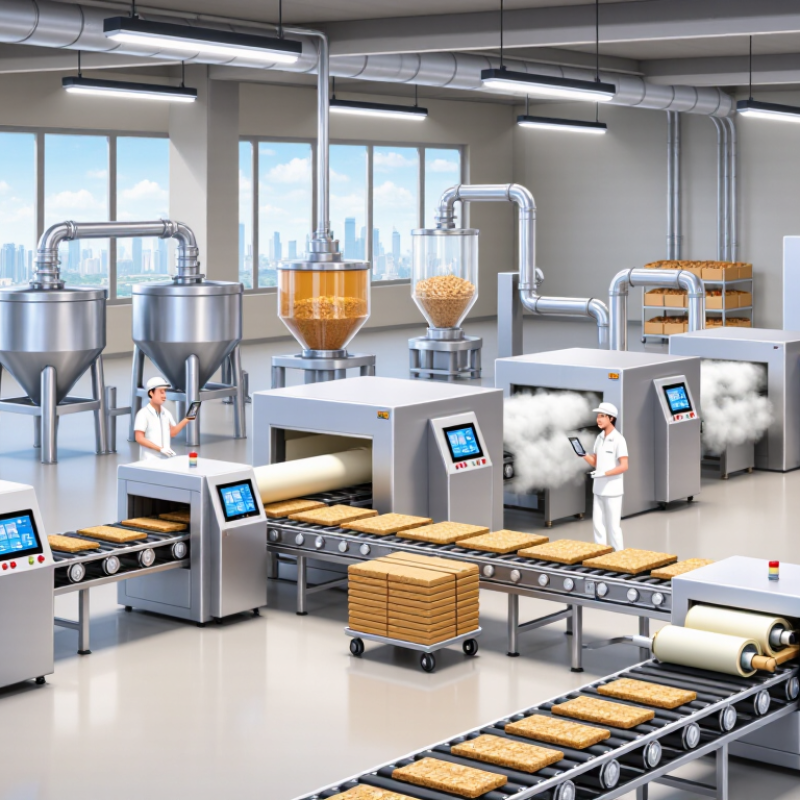
A cereal bar production line manufacturer is defined by more than stainless steel equipment. Real expertise appears in controlled mixing, gentle forming, accurate cutting, and stable cooling. Experienced teams understand that oats, syrups, nuts, and dried fruit behave differently. They adjust pressure and temperature without damaging texture. Small changes matter. A few degrees can alter binding, shelf stability, and bite. Good manufacturers document these decisions through tested process records, not sales claims.
Reliability begins before installation. A capable supplier studies the recipe, target capacity, bar dimensions, packaging method, and factory conditions. Engineers should inspect product flow from hopper to wrapper. They should verify cleanability, food-contact materials, guarding, and accessible maintenance points. Factory acceptance tests are valuable when they use the customer’s ingredients. Laboratory data helps, but production trials reveal sticky conveyors, uneven weights, or cooling delays. These findings should be recorded honestly.
Authority comes from repeatable performance and informed support. Training should cover recipes, changeovers, sanitation, troubleshooting, and spare-part planning. Response time matters when a cutter drifts or a depositor blocks. Yet no manufacturer can promise perfect output forever. That promise deserves caution. Even a well-designed line may need adjustment after seasonal ingredients change. The strongest partnership leaves room for feedback, redesign, and measurable improvement. Ask for references, validation records, and clear limits before signing. A polished brochure is not enough.
| Evaluation Dimension | Typical Industry Benchmark | What a Qualified Manufacturer Should Provide | Recommended Verification Evidence |
|---|---|---|---|
| Product Compatibility | At least 3 formulation categories, such as granola bars, pressed cereal bars, nut bars, or fruit-and-cereal bars | Interchangeable forming, cooling, cutting, and wrapping configurations suitable for products with different moisture, fat, syrup, and particulate levels | Product trials using the customer’s actual recipe, ingredients, target dimensions, and packaging format |
| Production Capacity | Approximately 50–1,000 kg/h is a common equipment-design range, depending on bar size, recipe, forming method, and line configuration | Clearly stated rated capacity, operating capacity, acceptable product-size range, and assumptions used for the calculation | Factory acceptance test results showing output, product weight, reject rate, and sustained operating time |
| Bar-Size Flexibility | Adjustable bar length, width, thickness, and weight; final limits depend on the forming and cutting system | Servo-controlled or mechanically adjustable forming and cutting components with documented changeover procedures | Dimensional samples covering at least two or more product specifications |
| Ingredient Handling | Separate handling capability for dry particulates, binders, inclusions, and sensitive ingredients | Controlled dosing for cereals, nuts, seeds, dried fruit, chocolate inclusions, syrups, and other recipe components without excessive breakage | Dosing accuracy test, ingredient-loss report, and trial results for the most fragile inclusion |
| Forming and Cutting Accuracy | Stable bar shape and consistent portion weight within the tolerance agreed in the production specification | Uniform compression, clean cutting, adjustable pressure, and controls that reduce edge damage and product deformation | Statistical weight checks, dimensional measurements, and visual inspection records from a production run |
| Cooling and Setting | Temperature-controlled conveying or cooling designed to set the binder before cutting and wrapping | Adjustable cooling-zone temperature, airflow, conveyor speed, and residence time matched to the recipe’s setting behavior | Temperature mapping, product-core temperature records, and confirmation that bars do not stick or collapse during transfer |
| Food-Contact Construction | Stainless steel 304 is widely used for general food-contact equipment; stainless steel 316 may be selected for higher corrosion resistance | Documented material specifications, hygienic welds, accessible surfaces, suitable seals, and food-grade lubricants where required | Material certificates, component datasheets, weld-finish information, and food-contact declarations applicable to the destination market |
| Hygienic Design | Open, drainable, cleanable construction with minimal product-retention points | Tool-free or low-tool access to product-contact areas, sloped surfaces where appropriate, removable guards, and documented cleaning procedures | Hygiene risk assessment, cleaning validation or verification records, and inspection of inaccessible areas |
| Automation and Controls | PLC-based control with HMI recipe management, alarm history, variable-speed drives, and interlocked safety functions | Recipe storage, password-controlled access, production data visibility, emergency stops, guarding, and communication options for plant systems | Control-system architecture, I/O list, safety circuit documentation, and demonstration of recipe recall and alarm handling |
| Packaging Integration | Compatibility with horizontal flow wrapping, multipack collating, carton loading, or other downstream packaging systems | Matched transfer speeds, product-spacing control, film registration support, and clear interface requirements between equipment modules | Integrated line test using the intended wrapper, film, bar dimensions, and packaging speed |
| Quality and Food-Safety Systems | Manufacturing processes aligned with HACCP principles and, where applicable, ISO 22000 or equivalent food-safety management requirements | Traceable component records, risk-based quality controls, documented inspection points, and support for customer validation requirements | Quality manual, applicable certifications, inspection plans, and corrective-action records |
| Regulatory Adaptability | Equipment configuration adjusted to the legal and electrical requirements of the destination country | Support for applicable food-contact, machinery-safety, electrical, labeling, and documentation requirements without relying on one universal configuration | Country-specific compliance checklist, declarations, technical file, and electrical documentation |
| Changeover Performance | Repeatable product changeover with documented setup parameters and cleaning steps | Quick-release parts, indexed adjustments, stored recipes, clear line-clearance procedures, and changeover-time measurement | Observed changeover test between two bar formats, including sanitation, adjustment, restart, and first-good-product time |
| Overall Equipment Effectiveness | Measured using availability, performance, and quality rather than rated speed alone | Transparent calculation of planned stops, unplanned downtime, speed losses, waste, rework, and good output | Production-run report with downtime codes, actual output, waste percentage, and quality results |
| Installation and Commissioning | Factory testing followed by documented site installation, commissioning, and operator training | Layout drawings, utility requirements, installation manuals, commissioning protocol, training agenda, and spare-parts recommendations | Signed factory and site acceptance test documents with open-item and handover records |
| After-Sales Support | Structured support for spare parts, troubleshooting, preventive maintenance, and software or controls assistance | Defined response process, recommended critical spares, maintenance schedules, remote-support procedure, and service documentation | Service-level terms, spare-parts list, maintenance checklist, and support contact process |
| Total Cost of Ownership | Assessment based on purchase price plus utilities, labor, changeover time, waste, maintenance, consumables, and expected service life | Lifecycle cost estimate with transparent assumptions for energy, compressed air, cleaning, wear parts, staffing, and production availability | Five-year cost model supported by utility data, maintenance intervals, consumable prices, and agreed operating assumptions |