| Manual Lever-Press Machine | A hand-operated lever applies mechanical pressure to compact prepared soil in a mould. | Approximately 300–800 blocks per day, depending on soil preparation and labour. | Human operation; no electricity is normally required. | Small to medium solid or interlocking blocks; dimensions depend on the mould. | Moist subsoil, sand-clay mixtures, and soil with a small stabiliser content. | Basic compaction, moulding, and demoulding for low-volume production. | Rural housing, community buildings, emergency shelters, and small construction projects. |
| Hydraulic Compressed-Earth-Block Machine | A hydraulic cylinder compresses measured soil inside a mould at controlled pressure. | Approximately 800–3,000 blocks per day for small and medium production lines. | Commonly driven by an electric motor; hydraulic power varies by machine configuration. | Solid, hollow, and interlocking blocks with interchangeable mould options. | Selected soil, sand, clay, and stabilised earth mixtures. | Controlled compaction, consistent block density, and repeatable moulding. | Residential walls, schools, clinics, boundary walls, and sustainable building programmes. |
| Mechanical Toggle-Press Machine | A toggle, eccentric, or flywheel mechanism transfers mechanical force to the mould. | Approximately 1,000–4,000 blocks per day, depending on automation and mould size. | Usually powered by an electric motor; manual feeding may still be required. | Standard solid blocks, interlocking blocks, and selected paving shapes. | Moist earth mixes and soil-cement blends prepared to a controlled moisture level. | Repeated pressing, fast cycle operation, and medium-volume production. | Small commercial buildings, housing developments, farm buildings, and public works. |
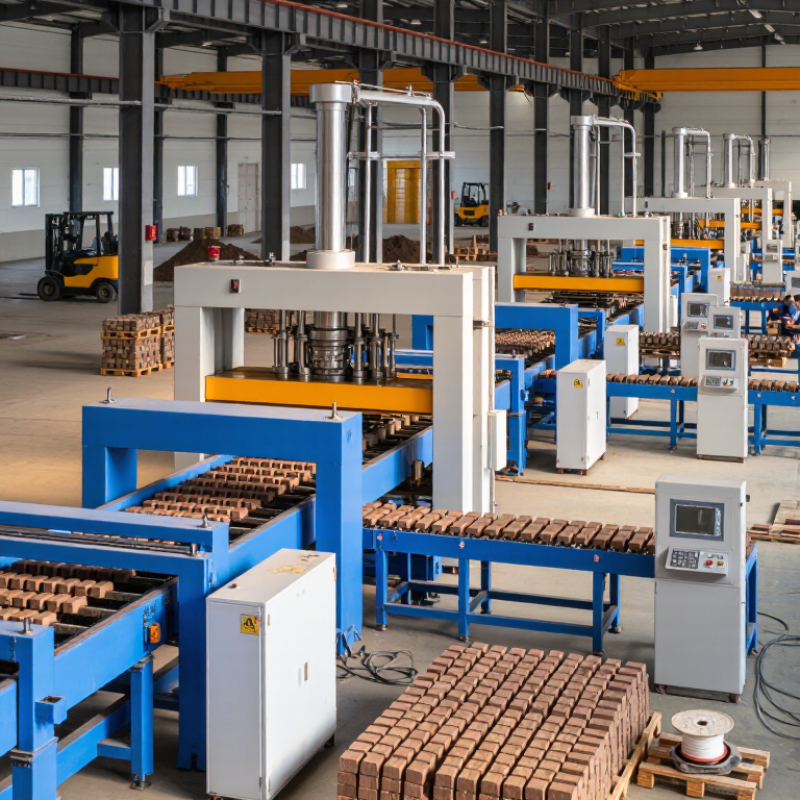
| Automatic Earth-Block Production Line | Integrated equipment handles batching, mixing, feeding, pressing, and block transfer. | Often 3,000–10,000 or more blocks per day, depending on line layout and working hours. | Three-phase electrical supply is commonly required; exact voltage and power depend on configuration. | Multiple block sizes, hollow blocks, interlocking blocks, and special mould profiles. | Processed soil, sand, clay, water, and optional cement or lime stabilisers. | Automated batching, mixing, pressing, palletising, and production monitoring. | Large housing projects, infrastructure programmes, commercial production, and export-oriented facilities. |
| Adobe Brick Moulding Machine | Forms relatively wet earth mixtures into moulds; the bricks are then air-dried rather than fired. | Capacity varies widely, commonly about 500–2,000 bricks per day for small production equipment. | Manual or motor-assisted operation; drying requires open space and suitable weather conditions. | Traditional rectangular adobe bricks and project-specific mould sizes. | Clay-rich earth, sand, water, and natural fibre additives where local practice requires them. | Wet forming, shaping, and preparation of sun-dried masonry units. | Traditional housing, restoration work, earthen architecture, and dry-climate construction. |
| Stabilised Soil-Block Machine | Compacts earth mixed with a measured stabiliser to improve strength, dimensional stability, and moisture resistance. | Approximately 1,000–5,000 blocks per day, depending on press type and material handling. | Manual, hydraulic, or electric operation; a mixer and soil sieve are commonly used upstream. | Solid or interlocking compressed-earth blocks, with optional hollow-core designs. | Graded soil, sand, water, and cement or lime stabilisers selected through soil testing. | Proportioning, compaction, dimensional control, and production of more durable earth blocks. | Urban housing, schools, public buildings, water-management structures, and humid-region projects. |
| Interlocking Mud-Block Machine | Presses shaped blocks with projecting and recessed profiles that fit together during wall construction. | Approximately 800–4,000 blocks per day, depending on the number of cavities and production cycle. | Available in manual, hydraulic, and electric configurations. | Interlocking solid or hollow blocks designed to reduce mortar use. | Compressed earth, soil-cement, and other tested stabilised soil mixtures. | Profiled moulding, accurate block alignment, and reduced dependence on thick mortar joints. | Affordable housing, rural construction, disaster-recovery projects, and self-build programmes. |
| Mobile or Trailer-Mounted Block Machine | A compact press and material-handling system is transported between construction sites. | Typically 500–3,000 blocks per day, depending on setup time, labour, and site conditions. | May use manual operation, a small engine, or a local electrical supply. | Project-specific solid, hollow, or interlocking blocks. | Locally sourced soil and stabilised earth prepared near the building site. | On-site block production, lower transport demand, and flexible deployment. | Remote communities, temporary construction camps, rural roads, and decentralised housing projects. |